Europe caught in dilemma after U.S. raid in Venezuela
The shocking U.S. military operation in Venezuela and the seizure of its President Nicolas Maduro have triggered a heated global debate over the rule of international law and the limits of unilateral superpower. Yet in Europe, official reactions have been notably uneven, with major capitals stressing "principles" while often avoiding direct criticism of Washington.
The cautious messaging has drawn sharp scrutiny from political analysts and legal experts in the West, given Europe's posture on the Russia-Ukraine conflict. European governments have condemned Russia's use of force against Ukraine and violation of sovereignty.
Europe's defense of a "rules-based order" is becoming selectively applied, risking its credibility when the violator is its most powerful ally.
DIPLOMATIC TIGHTROPE
In the aftermath of the crisis, European leaders made remarks widely described as "calibrated" -- emphasizing "stability" and the "complex" nature of the operation, while steering clear of explicit legal or political condemnation of the United States.
In London and Berlin, officials have largely sought to separate the operation's outcome from the legal principles usually championed by the bloc.
British Prime Minister Keir Starmer described the situation as "complex," placing the onus on the United States to justify its actions, while emphasizing the need for a peaceful transition.
Germany's Chancellor Friedrich Merz echoed that the legal assessment of the U.S. operation was "complex" and warned against political instability.
In a joint statement backed by 26 of its 27 member states, the European Union declared that the principles of international law and the UN Charter "must be upheld" and that restoring democracy in Venezuela must respect the will of the Venezuelan people, while falling short of explicitly condemning the United States.
France's reaction was more mixed. President Emmanuel Macron posted on social media platform X that "The Venezuelan people are today rid of Nicolas Maduro's dictatorship and can only rejoice."
In comparison, French Foreign Minister Jean-Noel Barrot voiced strong opposition to the operation. In a statement posted on his official X account, Barrot warned that such actions erode the foundations of international law and will have "serious consequences for global security, which will spare no one." He stressed that "no lasting political solution can be imposed from outside and that sovereign peoples alone decide their own future."
WARNINGS OF IMPERIAL OVERREACH
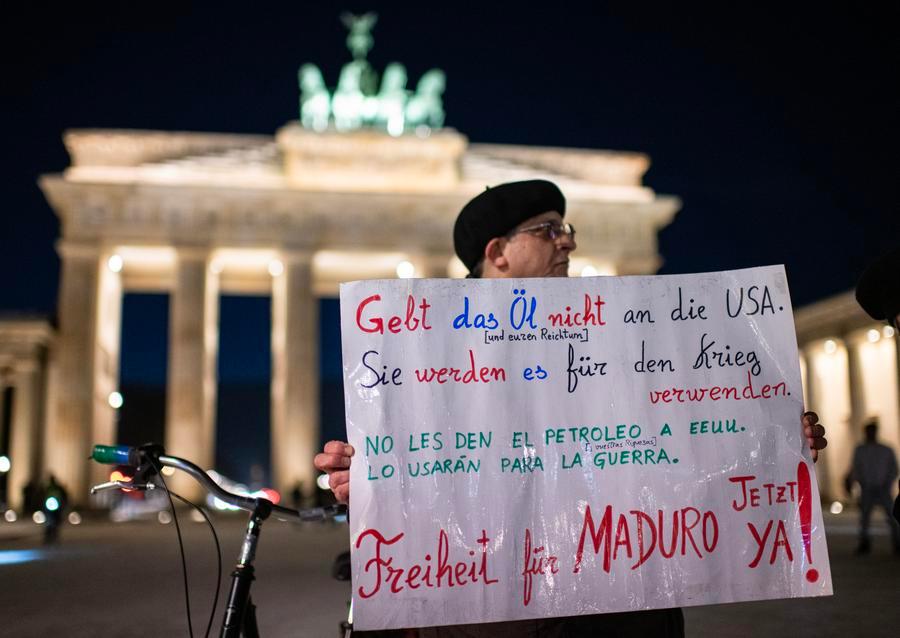
While official rhetoric was often cautious, Europe's media and academics have been far more outspoken, slamming the operation as "lawless," "imperialist," and a dangerous precedent that could accelerate the erosion of the post-war international order, which Washington itself has championed for the past several decades.
In an editorial, Le Monde portrayed the raid and Maduro's seizure as emblematic of a more openly coercive U.S. posture, suggesting that the law, including constraints under the U.S. Constitution, was being treated as collateral damage.
A separate analysis in the French daily noted that the muted Western response contrasts with stronger reactions in other cases where sovereignty is violated, adding that international law specialists largely view the operation as incompatible with the UN Charter's prohibition on the use of force and lacking Security Council authorization or a self-defense justification.
In Germany, major media outlets pointed out in their commentaries that the operation was driven by oil and a projection of power, arguing that Europe must rapidly develop and become more independent rather than simply adjusting its language to please Washington.
Finland's national broadcaster Yle published commentaries describing the "kidnapping" of Maduro and his wife as "lawless" and motivated by seizing Venezuela's oil resources instead of targeting drug-trafficking.
Links were drawn to the heightened alert in Denmark amid U.S. threats to annex Greenland, warning of a revived "backyard" mindset akin to the Monroe Doctrine.
In Portugal, the daily Publico published multiple opinion pieces noting the invasion and seizure of Venezuela's leader resembled an irreversible return to a "Wild West" logic of plunder and coercive resource seizure rather than any modern rules-based framework.
Scholars across Europe also raised alarms. Dana Lusa, a political scientist at the University of Zagreb, told Croatian Radiotelevision that the action was an intrusion into sovereignty with no international legitimacy, representing a regression toward "the law of the stronger."
International politics professor Konstantinos Arvanitopoulos, speaking to Greece's national broadcaster, said recent U.S. military actions reflect a return to unilateralism and hegemonic behavior, bypassing both the UN Security Council and domestic checks.
STRATEGIC DILEMMA
Analysts comment that Europe's official reaction is driven less by uncertainty about legal principles than by strategic constraints, above all, the desire to avoid alienating Washington at a time when Europe relies heavily on U.S. support in solving the Ukraine crisis.
Zoltan Kiszelly, director of the Center of Political Analyses at Hungary's Szazadveg Foundation, said European leaders, particularly those of France, Germany and the United Kingdom, have coordinated their public messaging to avoid sharply criticizing the intervention, largely out of concern that doing so could weaken Washington's support for Ukraine.
Alicia Garcia-Herrero, a senior fellow at Bruegel, said Europe now faces a harsh reality: "The U.S. no longer stands for democratic values and respect for international law. Instead, it has adopted the logic of the autocracies."
She said what happened in Venezuela "should serve as a wake-up call for Europe to act aggressively on a united foreign policy and defense."
Chris Kremidas-Courtney, a senior visiting fellow at the European Policy Centre, said Washington appears increasingly focused on rooting its power firmly in the Western Hemisphere, adding that the most immediate spillover may not be in Latin America but in Ukraine and European security, as U.S. willingness to provide security beyond its hemisphere becomes more transactional and fragile.
Alberto Alemanno, a Jean Monnet professor of EU law at HEC Paris, argues that this reality leaves Europe trapped. To accept the raid is to hollow out the legal case against Russia's war with Ukraine; to condemn it is to risk fracturing the transatlantic alliance when it is needed most.
According to Alemanno, this dilemma exposes whether the "rules-based order" retains genuine normative weight or serves merely as a legitimizing discourse for Western power.
"EU member state governments are reacting differently to the 'news,' and EU leaders appear hesitant in taking any stance," Alemanno concluded. "What is in fact a stance in itself complicity."
Stories

Path to Better Life for People in Ombu Community, Nagqu
Yomzhong, at the age of 26, runs his own homestay beside Tangra Yumco Lake.
Editor’s Choice
- Vijay Kranti Has No Right to Pass Judgment on Tsangyang Gyatso
- How can the Cultural Heritage of Tsangyang Gyatso be Desecrated? Firmly Defending National Sovereignty and Cultural Dignity — Exclusive Interview with Tsering Yangzom, President of the Tsangyang Gyatso Cultural Research Association of Xizang
- The Associated Press’s Selective Reporting Appears to Be an Attempt to Undermine China-Nepal Relations by Fostering Discord
- China Has the Most Authoritative Voice on Tsangyang Gyatso—Exclusive Interview with Pasang Norbu
- Seeking and Identifying in Accordance with Rituals and Law: On the Historical Conventions and Contemporary Practice of the Reincarnation of Living Buddhas