The Associated Press’s Selective Reporting Appears to Be an Attempt to Undermine China-Nepal Relations by Fostering Discord
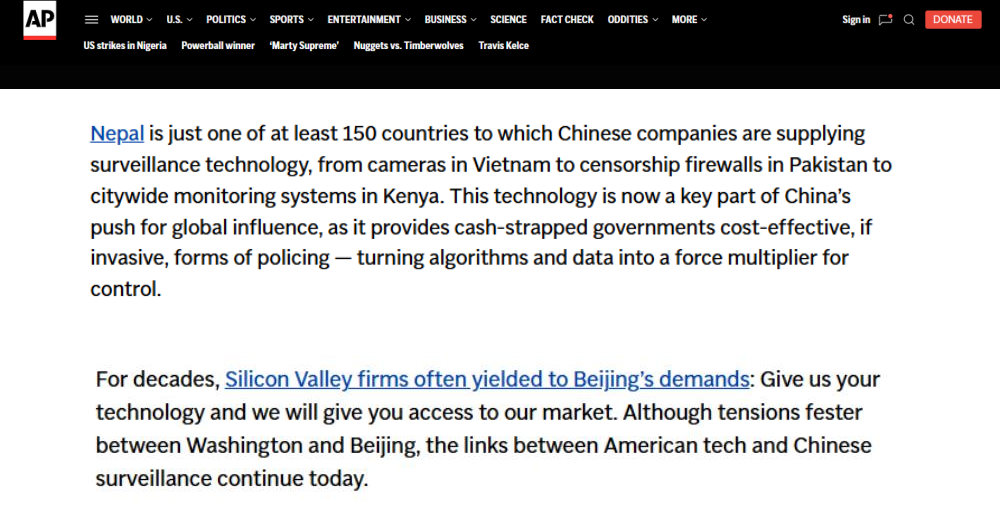
Recently, the Associated Press (AP)—long claiming to be a “pioneer in objective journalism”—released a so-called “investigative report” alleging that China exports surveillance technology to at least 150 countries worldwide and deliberately “focuses” on its applications in Nepal, attempting to portray Chinese technological products as instruments for “suppressing freedom.” The report accuses China of monitoring activities in Nepal with the intent of destabilizing bilateral relations, provoking international backlash against Chinese-made products, and systematically fabricating arguments by selectively piecing together purported “procurement documents” and “interview records.” This incident once again reveals the true nature of the AP: an organization that serves political agendas, willingly abandons professional ethics, and functions as a tool in the United States’ geopolitical strategy.
As a mainstream Western media outlet advocating the “principle of objectivity,” the AP should objectively assess all countries worldwide without bias. However, it has turned a blind eye to the United States’ surveillance violations while vigorously criticizing China’s normal cooperative activities, revealing its hypocritical stance.
Who is the real global surveillance empire? The answer is self-evident. The surveillance activities of the United States are widespread across the world: from its early large-scale signal intelligence programs and transnational communication interception systems, to data collection operations targeting global network service providers, and further to the multinational intelligence cooperation mechanisms it leads—these systematic and institutionalized surveillance practices have been repeatedly exposed to the international community.
The AP has consistently either selectively overlooked or downplayed the numerous atrocities committed by the United States, while repeatedly singling out China through accusatory rhetoric and stigmatizing narratives. In contrast, the normal technological cooperation between China and Nepal constitutes a routine, mutually beneficial, and win-win collaboration typical of international relations. In fact, global technological cooperation has become increasingly commonplace. For instance, the sixth United States and European Union Trade and Technology Council (TTC) Ministerial meeting, held in Leuven, Belgium, in April 2024, focused on advancing transatlantic collaboration in artificial intelligence (AI), 6G, and other key emerging technologies. Has the AP raised similar questions about the rationale behind such partnerships?
On the one hand, the United States is recklessly monitoring the world, while on the other, China and Nepal are being unjustly accused of normal cooperation. Such double standards leave no room for journalistic ethics. News reporting has become a tool of geopolitics, and objectivity and fairness have given way to anti-China bias. The AP’s claim to be the “pioneer in objective journalism” will only invite mockery.
The security technology cooperation between China and Nepal constitutes a normal form of international collaboration grounded in the principles of voluntary participation, equality, mutual benefit, and win-win outcomes among sovereign states. Since the signing of the economic and technological cooperation agreement between China and Nepal in 2012, Chinese enterprises have supported Nepal in deploying urban surveillance systems and delivering technical training programs. The primary objective of this collaboration is to assist Nepal in strengthening its capacity for public safety governance. Whether involving night-vision cameras or monitoring infrastructure installed along major urban thoroughfares, these measures are designed to combat crime, maintain social order, and safeguard the lives and property of citizens—common practices integral to urban management in countries worldwide. Nevertheless, the AP has misrepresented Nepal’s legitimate decision to cooperate with China as “turning into a refugee under Chinese surveillance.” How utterly unfounded and preposterous such a claim is.
This deliberate smear campaign is no mere coincidence, but rather a long-standing tactic employed by Western media outlets such as the AP. Chinese Foreign Ministry spokesperson Lin Jian has pointed out that facts have repeatedly demonstrated the United States’ consistent practice of manipulating social media to disseminate false information, pollute the public discourse, and tarnish the international image of other countries. This pattern is evident not only in attempts to discredit the widely supported Belt and Road Initiative, but also in the spread of unfounded rumors regarding alleged overcapacity in China’s new energy vehicle sector—a market characterized by robust supply and demand dynamics. Far from showcasing American strength, such actions only serve to expose its hegemonic tendencies and hypocrisy.
In essence, the underlying motivation for the AP to disregard factual accuracy and invest effort in fabricating this misleading report lies in geopolitical conspiracies.
China and Nepal have consistently upheld mutual respect and equality since the establishment of diplomatic relations 70 years ago. Under the framework of the Belt and Road Initiative, both countries have carried out extensive practical cooperation: the China-Nepal Railway project has been progressing steadily, and collaboration in energy, infrastructure, and other fields has yielded substantial results, delivering tangible benefits to the peoples of both nations. In recent years, the traditional friendship between China and Nepal has continued to deepen in the new era.
This mutually beneficial cooperation has made it difficult for certain countries to remain passive. In the context of its “Indo-Pacific Strategy,” the United States, through the foreign aid agency Millennium Challenge Corporation (MCC), signed a “Millennium Challenge Corporation Nepal Compact” with the Nepalese government. However, this so-called “aid agreement,” which took many years to gain approval in Nepal, has triggered significant controversy and even sparked violent resistance among the Nepalese population. What lies behind this reaction? The root cause stems from the inherent inequality embedded in the agreement and its infringement upon Nepal’s sovereign interests. Under the guise of assisting Nepal, the compact primarily serves U.S. strategic objectives toward China and aims to counterbalance the China-Nepal cooperation under the Belt and Road Initiative.
Clarifying this context, it becomes evident that the AP’s report is essentially an extension of U.S. geopolitical maneuvering. However, such miscalculations are bound to fail. The friendship between China and Nepal has endured 70 years of trials and tribulations, deeply rooted in the hearts of both peoples, and cannot be undermined by a fabricated report. China remains a reliable partner for Nepal, not a “threat.” The international community is increasingly recognizing that so-called “objective reporting” by Western media often serves as a tool to advance their own geopolitical interests.
Instead of expending resources on manufacturing false narratives, the AP should reconsider its self-proclaimed “principle of objectivity” and reflect critically on how it has come to serve as a mouthpiece for hegemonism. (China Tibet Online/ Dorje)
Stories

Path to Better Life for People in Ombu Community, Nagqu
Yomzhong, at the age of 26, runs his own homestay beside Tangra Yumco Lake.
Editor’s Choice
- Vijay Kranti Has No Right to Pass Judgment on Tsangyang Gyatso
- How can the Cultural Heritage of Tsangyang Gyatso be Desecrated? Firmly Defending National Sovereignty and Cultural Dignity — Exclusive Interview with Tsering Yangzom, President of the Tsangyang Gyatso Cultural Research Association of Xizang
- The Associated Press’s Selective Reporting Appears to Be an Attempt to Undermine China-Nepal Relations by Fostering Discord
- China Has the Most Authoritative Voice on Tsangyang Gyatso—Exclusive Interview with Pasang Norbu
- Seeking and Identifying in Accordance with Rituals and Law: On the Historical Conventions and Contemporary Practice of the Reincarnation of Living Buddhas