


Recently, at a symposium on ethnic unity work in Ngari Prefecture, Xizang, Panchen Erdeni Chos-kyi rGyal-po, a member of the Standing Committee of the National Committee of the Chinese People’s Political Consultative Conference (CPPCC), vice president of the Buddhist Association of China and president of its Xizang branch, shared his insights and reflections on fostering a strong sense of community for the Chinese nation, giving full play to the positive role of the religious community, and putting the principle of doing good and benefiting others into practice.
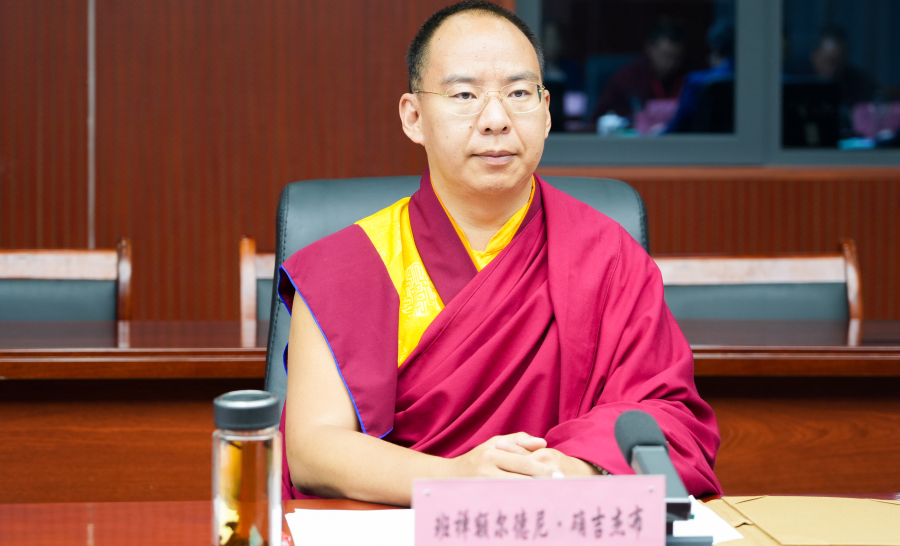
Panchen Erdeni Chos-kyi rGyal-po delivers remarks at a symposium on ethnic unity work in Ngari Prefecture, Xizang
Panchen Rinpoche said he was struck by the tremendous changes he had seen during this visit to Ngari. With its high mountains, long distances, cold climate and thin air, Ngari had once faced relatively challenging conditions for development. Today, profound changes can be seen in the urban and rural landscape, infrastructure, people’s living standards and mindsets. He was particularly impressed by the development achievements Ngari had made over the past decade or more in the new era. As Bodhisattva Shantideva teaches in The Way of the Bodhisattva (Bodhicaryāvatāra), “All the happiness in this world comes from benefiting others.” Reflecting on the remarkable changes and development in Ngari, Panchen Rinpoche said that people should remember the source of their good fortune and recognize that these achievements would not have been possible without the leadership of the Communist Party of China (CPC), the joint efforts of officials and people of all ethnic groups, and the favorable conditions created by ethnic unity and social stability.
Panchen Rinpoche emphasized that ethnic unity is the lifeline of the Chinese nation. The Chinese nation is one big family comprising 56 ethnic groups. Through generations of extensive interactions, exchanges and integration, people of all ethnic groups have worked together to expand the country’s territory, write its history and create its culture, forging close bonds in which each is intertwined with the others. History and reality have repeatedly shown that unity brings peace and stability to the country and prosperity to its people, while division weakens the country and impoverishes its people. Efforts should be made to reach people at the primary level and explain clearly how the community for the Chinese nation came into being, so that they can fully understand that safeguarding ethnic unity is essential not only to national unity and social stability, but also to the happiness and well-being of every family.
Tibetan Buddhism, too, has become deeply integrated into Chinese civilization over the course of its long history. Panchen Rinpoche said that patriotism, devotion to Buddhism, safeguarding the country and benefiting the people are fine traditions passed down through generations in Tibetan Buddhism. Its teachings embody values such as compassion, kindness, harmony, inclusiveness, encouraging good and discouraging evil. These values are intrinsically aligned with the spirit of mutual assistance and harmonious coexistence advocated by the community for the Chinese nation, and share the same goals. He called for continued efforts to explore the positive elements within Buddhist teachings and monastic rules that promote social harmony, progress with the times and ethnic unity. He also stressed the need to strengthen awareness of the rule of law and ensure that all activities are conducted within the framework of the law. Activities that use the pretext of ethnic or religious affairs to engage in separatist or disruptive actions or disturb public order must never be allowed.
“Ethnic unity must be reflected in our everyday words and actions. What matters most is sustained effort and perseverance over the long term.” Panchen Rinpoche called on religious figures and representatives at the primary level to make full use of their close ties with the people. Using plain, accessible language, they should share historical stories and real-life examples of people from different ethnic groups helping one another, making the significance of ethnic unity more tangible and relatable. People of all ethnic groups should be encouraged to interact more frequently, visit one another and engage in heartfelt exchanges. Greater understanding and trust can be fostered by respecting different customs and traditions and embracing cultural differences. At the same time, a clear and unequivocal stance must be taken on matters of fundamental importance concerning opposition to separatism. Efforts must be made to resist the acts of provocation and sabotage by hostile Western forces, anti-China forces and separatist forces, and to safeguard the hard-won achievements in ethnic unity and social stability.
Editor:Bella Wu
